These are my personal views and don’t represent my employer or any government agency. As a UX designer and accessibility advocate, I share insights on improving human experiences across industries.
Prologue
Of barriers, and the quiet invention of belonging

Before accessibility had a name, it had a consequence.
It lived in stone steps too high to climb, in doors too narrow to enter, in words printed too small to read. It existed wherever the world was built with an unspoken assumption: this place is not for you.
For most of human history, exclusion was not cruelty. It was default. Cities rose for the able-bodied. Tools were shaped for steady hands. Knowledge travelled through eyes that could see and ears that could hear. Those who could not adapt were expected to disappear quietly, or depend entirely on others.
And yet, in every age, someone noticed the gap.
Someone paused at the stair and asked why it had to be there.
Someone listened to silence and wondered how sound might become text.
Someone looked at a locked system and imagined a different kind of door.
This is not the history of compliance.
It is the history of interruption.
Accessibility did not arrive all at once. It learned. It stumbled. It was ignored. Then resisted. Then regulated. And finally, slowly, it began to reshape how we design the world itself.
This is the story of how access became a right, design became accountable, and justice found its way into systems that once pretended neutrality.
The age of stone, steel, and assumption
Early cities and exclusion

The earliest cities were monuments to human ingenuity, and to human oversight.
Stairs were everywhere. Temples rose on platforms. Government buildings announced power through elevation. To climb was to belong. To remain below was to be excluded. No one questioned this. It simply was.
Disability, when acknowledged at all, was treated as a personal misfortune, not a design failure. The burden of adaptation rested entirely on the individual. If you could not use the space, the space was not wrong. You were.
This logic endured for centuries.
Even as industrialization transformed societies, accessibility remained invisible. Factories, trains, and offices were designed for efficiency, not equity. Speed mattered. Standardization mattered. People who did not fit the standard were treated as exceptions: temporary, inconvenient, ignorable.
But wars change stories.
In the aftermath of the First and Second World Wars, millions of veterans returned home with injuries that permanently altered how they moved through the world. These were not marginal figures. They were workers, parents, voters, leaders. Franklin D. Roosevelt governed the United States from a wheelchair, largely hidden from public view. His disability was accommodated privately, but not yet acknowledged publicly.
And so, quietly, something radical happened.
Someone flattened the stairs.
The ramp, simple and almost embarrassingly obvious, became one of the first great accessibility revolutions. It did not ask for sympathy. It asked for geometry. A different angle. A different assumption.
What made the ramp revolutionary was not just who it helped. Wheelchair users gained access, yes. But so did parents with strollers, workers with carts, travellers with luggage.
Justice, it turned out, scaled.
This was the first lesson accessibility tried to teach us: when you design for those at the margins, you often improve life for everyone else.
We were slow to listen.
When law learned to speak (North America)
Rights, pressure, and the rise of enforceable accessibility
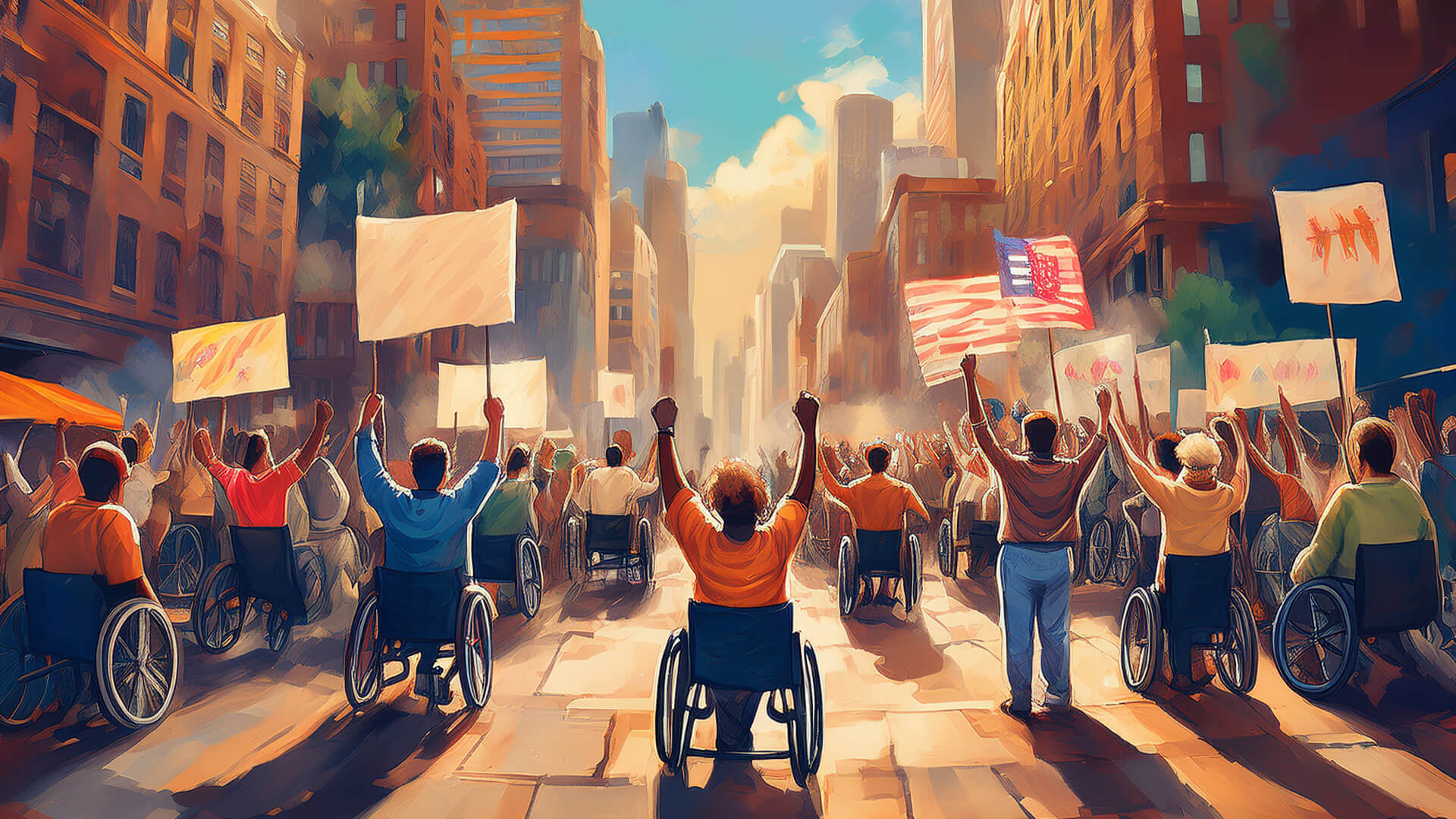
In North America, accessibility did not advance through goodwill alone. It advanced through pressure.
The civil rights movements of the mid-20th century reshaped how societies understood discrimination. Disability, long framed as a medical problem, began to be recognized as a social issue. The problem was not impairment. The problem was exclusion.
Activists like Ed Roberts, often called the father of the independent living movement, challenged the idea that people with disabilities should be hidden, institutionalized, or grateful for scraps of accommodation. They demanded access, autonomy, and dignity.
This momentum led to a turning point.
In 1990, the United States passed the Americans with Disabilities Act. The ADA did something unprecedented. It made access enforceable. Ramps, elevators, signage, and public services were no longer optional or charitable. They were rights.
Canada followed a parallel but distinct path.
Rather than a single sweeping act, Canada’s accessibility journey unfolded through provinces, shaped by public consultation and lived experience. In Ontario, this resulted in the Accessibility for Ontarians with Disabilities Act in 2005. Its promise was bold: a fully accessible province.
What made AODA significant was not only its scope, but its patience. Accessibility was framed not as a quick fix, but as a long-term cultural shift. Standards would evolve. Enforcement would mature. Organizations would adapt.
Then the digital world arrived.
Websites replaced counters. Apps replaced forms. Internal tools replaced offices. The stairs were gone, but the barriers remained. Screen readers failed. Keyboard users were locked out. Videos spoke without captions. Forms demanded precision from hands that could not provide it.
Once again, the system claimed neutrality.
Once again, accessibility exposed the lie.
Europe and the discipline of standards
Embedding accessibility into systems and regulation

If North America framed accessibility as a matter of rights, Europe approached it as a matter of systems.
Across the European Union, accessibility matured through regulation, procurement, and harmonization. Standards like EN 301 549 embedded accessibility into public-sector technology by default. If you wanted to sell software to governments, accessibility was not a feature. It was a requirement.
This shift mattered.
Accessibility stopped being aspirational and became operational. It had to be documented, tested, maintained. It had to survive procurement cycles, audits, and real-world use.
Designers began to notice something important.
The constraints they once resisted—contrast ratios, focus indicators, target sizes, semantic structure—were making products clearer and more resilient. Interfaces worked better under stress. Systems failed more gracefully. Users made fewer errors.
Accessibility was no longer the enemy of innovation. It was its editor.
Need help shaping your UX story?
From product strategy to accessibility and execution, I help teams and individuals clarify their vision and elevate their work. If you're serious about improving your UX outcomes, let’s talk.
Book a Free ConsultationPragmatism from the south (Australia)
Accessibility through necessity and practicality

Australia’s contribution to accessibility came through necessity.
With vast distances and dispersed populations, digital services were not conveniences. They were lifelines. Accessibility laws, anchored in the Disability Discrimination Act, forced public systems to confront real conditions: aging users, assistive technologies, inconsistent connectivity.
Here, accessibility became practical rather than philosophical.
And from that practicality emerged a quiet truth: accessibility works best when it stops being special. When it is embedded, expected, and unremarkable.
Justice, when normalized, becomes invisible.
The unfinished chapter (Africa and the global south)
Absences, opportunities, and building inclusive futures

Any honest history must name its absences.
Much of Africa remains underrepresented in global accessibility narratives. Not because disability is rarer, but because infrastructure, regulation, and enforcement are uneven. Yet this also makes the continent one of the greatest opportunities for accessibility-first design.
Mobile-first ecosystems. Voice-based interaction. Low-bandwidth solutions. Community-driven innovation.
In many regions, accessibility is not about retrofitting broken systems. It is about building just ones from the start.
The next great accessibility heroes may not come from correcting legacy platforms, but from designing futures that never excluded in the first place.
The digital renaissance
How technology amplified accessibility for everyone

In the digital age, accessibility found its most transformative medium.
- Screen readers turned structure into speech.
- Captions turned sound into text.
- Predictive text reduced cognitive load.
- Voice interfaces turned interaction into conversation.
Many of these innovations were born from disability, but adopted by everyone.
Today, millions use captions without identifying as Deaf. Millions rely on predictive text without having dyslexia. Millions navigate interfaces one-handed, distracted, tired, or injured.
Accessibility stopped being visible. That is when it became powerful.
It also became profitable.
Accessible products reach more users, perform better in search, reduce friction, and earn trust. Justice, it turns out, is not anti-capitalist. It is expansive. Inclusion grows markets. Exclusion shrinks them.
Doing the right thing, again and again, proves to be good business.
Epilogue
Inheritance, and the question of the next hero

Accessibility is no longer young.
It has survived neglect, skepticism, and reductionism. It has been shaped by activists, enforced by law, refined by designers, and validated by millions of users who simply wanted to participate.
What remains unfinished is not the standard. It is the will.
Every designer inherits this history.
Every business leader benefits from it.
Every product decision either advances justice, or quietly erodes it.
For centuries, justice has been seen as the foundation of lasting societies. Accessibility is one of the ways we put that principle into practice today.
So the final question is not what accessibility is, or even why it matters.
The question is this:
Who will be the next hero in this long story of access?
Will it be the designer who refuses to ship exclusion?
The developer who insists on semantic truth?
The leader who understands that dignity scales, and profit follows?
History is still being written.
And accessibility is still waiting for its next champion.